

The fauna of the Tibetan plateau at 1:20
Kiang, bharal and Przewalski’s gazelle: three animals from the roof of the world, and why they form a series of their own in the collection.


Most of the extinct animals in the collection come from far away: the Siberian steppe, the pampas, the forests of New Zealand. The Miocene series is the exception. Several of its pieces are animals that lived nine to ten million years ago a short drive from the centre of Madrid, on a low hill called the Cerro de los Batallones.
The first fossils at Batallones, in the municipality of Torrejón de Velasco, turned up by chance in July 1991, during quarrying on the hill. Excavations since then have identified nine separate sites, all from the late Miocene, between about 9.8 and 9.1 million years ago.
What makes Batallones exceptional is not only the quality of the bones but whom they belong to. In most fossil sites plant-eaters vastly outnumber predators, as they do in any living ecosystem. In Batallones-1, nearly every fossil is a carnivore. The cavities in the hill seem to have worked as natural traps: animals that climbed or fell in, perhaps drawn by water or by trapped prey, could not get out again, and the predators that came after them shared their fate.
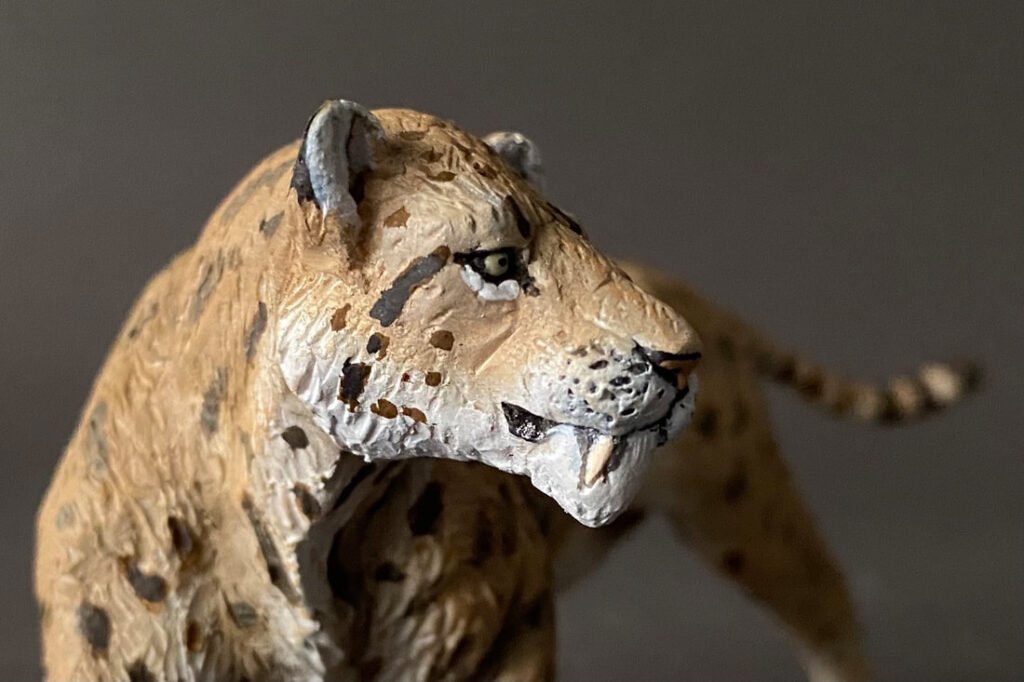
The result is one of the richest Miocene carnivore assemblages known: two saber-toothed cats, Machairodus aphanistus and the leopard-sized Promegantereon ogygia; a bear, Indarctos arctoides; Simocyon batalleri, a distant relative of the red panda; bear-dogs; and several smaller hunters.

Machairodus aphanistus was a lion-sized cat and one of the earliest true saber-tooths. Its canines are long and flattened, but broader and less extreme than those of later forms such as Smilodon. Batallones produced the first complete skull of the species, and enough individuals to study how it varied from one animal to the next, something almost never possible with a fossil predator.
The plant-eaters of Batallones have their own surprises. Decennatherium rex, described in 2017 from material found here, was a relative of the giraffe and the okapi with four ossicones: a small pair above the eyes and a much larger pair behind them. It is the earliest known member of the lineage that would later produce Sivatherium, the massive giraffid of Africa and Asia.
The species list from Batallones reads like the Miocene series of the collection. Alongside the predators lived Tetralophodon longirostris, a long-jawed proboscidean with tusks in both jaws; Aceratherium incisivum, a rhinoceros with no horn at all; and the three-toed horse Hippotherium primigenium, still widely known by its older name, Hipparion primigenium, which is the one used in the catalogue.
Displayed together, they are not a selection of famous fossils but a single community of animals that lived and died in the same place.
Titanochelon bolivari belongs with this series, but not with this hill. The giant tortoise was first described in 1917 from the Cerro del Viso, in Alcalá de Henares, east of Madrid, and comes from the middle Miocene, several million years before the Batallones traps. Its shell approached two metres in length: gigantism in tortoises was once a continental phenomenon, not only an island one. Madrid still produces them. In July 2026, remains of a giant tortoise more than 15 million years old turned up during building works in the city.
Kiang, bharal and Przewalski’s gazelle: three animals from the roof of the world, and why they form a series of their own in the collection.

Six stages, none of them mechanised: how a replica goes from a study of the animal to a hand-painted resin cast, and how to look after one.