


The fauna of the Tibetan plateau at 1:20
Kiang, bharal and Przewalski’s gazelle: three animals from the roof of the world, and why they form a series of their own in the collection.

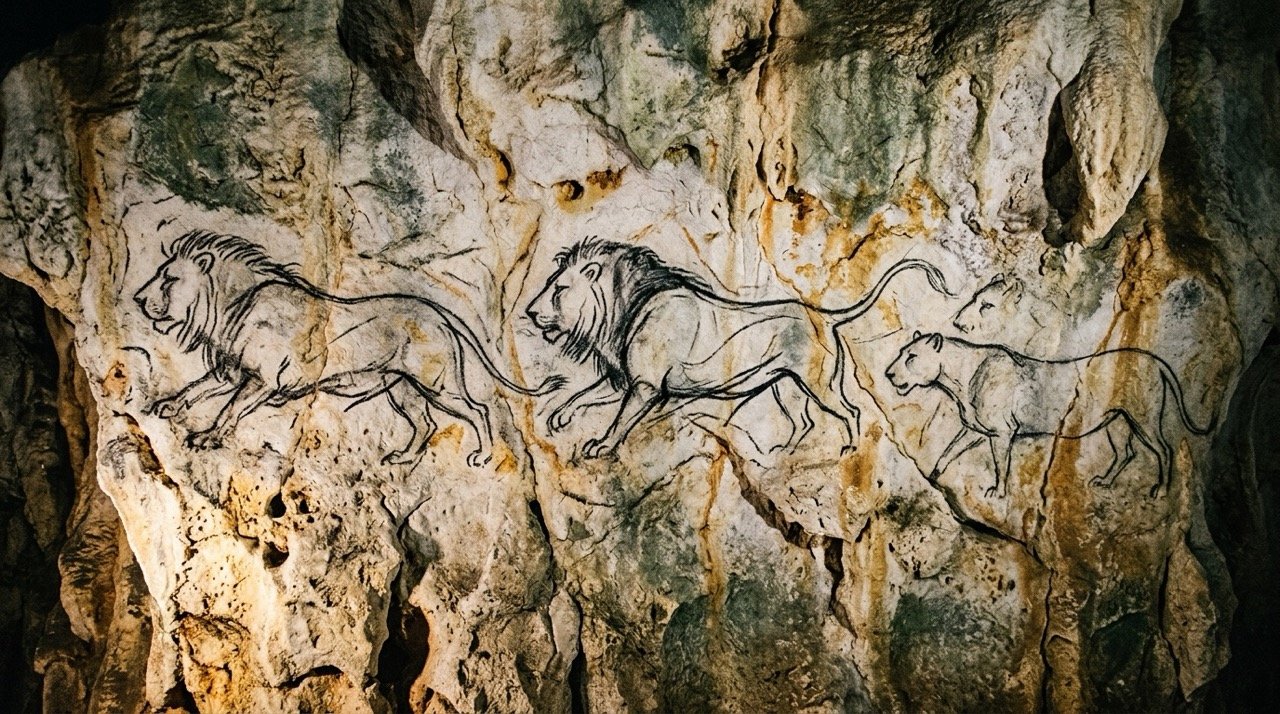
Ask anyone to picture a lion and the mane comes first. It is the one feature that sets a male lion apart from every other big cat, and the first thing most artists reach for when they reconstruct an extinct one. For the cave lion, Panthera spelaea, the evidence points the other way.
The cave lion ranged across the cold steppes of the Pleistocene, from the Iberian Peninsula to Alaska and the Yukon, and survived until roughly 14,000 years ago. It was a big animal, as large as the largest living lions or a little larger, and for a long time it was treated simply as an Ice Age population of the modern species.
Ancient DNA has changed that picture. Cave lions belong to a separate lineage that had been evolving apart from modern lions for at least half a million years, and many researchers now treat Panthera spelaea as a species in its own right. That matters for a reconstruction: there is no reason to assume that a cave lion looked like an African lion with a thicker coat.
The best evidence for the cave lion’s appearance was left by people who watched it alive. In the Chauvet cave, in the Ardèche gorges of southern France, painters working around 36,000 years ago drew lions in remarkable numbers. In the deepest chamber, a long frieze of lions in charcoal stretches across the rock, heads lowered and outstretched as if stalking.
None of them has a mane. One pair is particularly telling: two lions walking side by side, the one behind drawn larger and with its scrotum clearly shown. It is unmistakably a male, and it has no mane at all.
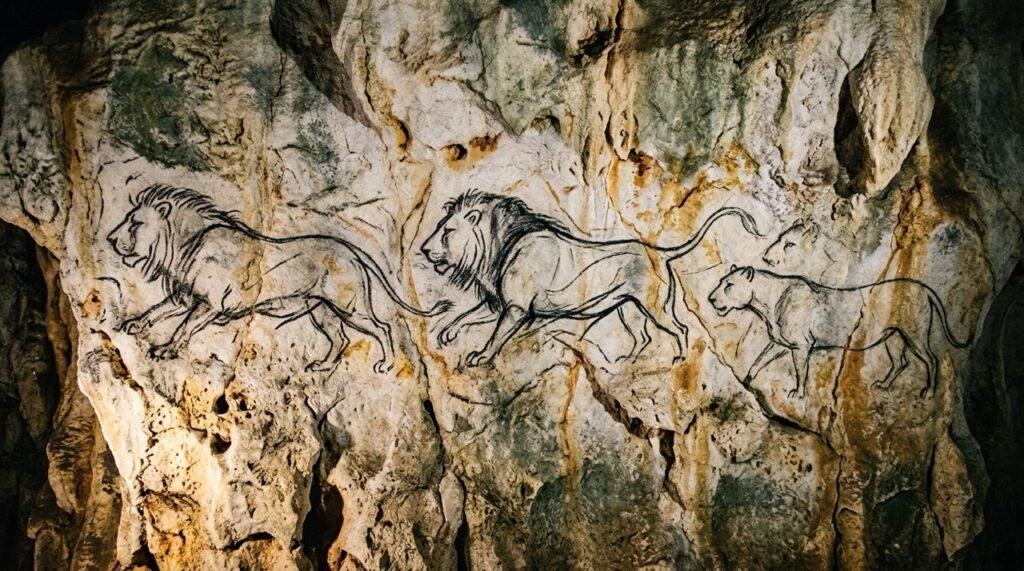
Cave art is not photography, and leaving out a feature can be a matter of convention. But Chauvet is not an isolated case. Across Palaeolithic art, lions are drawn almost without exception without manes; at most, a few show a slight ruff around the neck. When artists separated by thousands of years keep leaving out the most recognisable feature of a lion, the simplest explanation is that the animal did not have it, or had only a modest one.
Since 2015 the permafrost of Yakutia, in northeastern Siberia, has given up several frozen cave lion cubs, some of them tens of thousands of years old and preserved with skin and fur intact. Being cubs, they say nothing directly about manes. What they do confirm is what the climate suggests: a dense, long coat with thick underfur, built for the cold steppe rather than the African savannah.
The 1:20 cave lion in the collection is a male, and it is modelled without a mane. The body is long and low, sixteen centimetres from end to end at this scale, with the heavy forequarters of a predator that brought down reindeer, horses and other large grazers.
The decision has a cost. To anyone used to the modern animal, a maneless male looks less like a lion, and a mane would make the piece instantly readable on a shelf. But a reconstruction that ignores the only eyewitness accounts we have is not really a reconstruction.
For collectors building a larger Ice Age scene, the same animal is also available as a 1:35 figure, printed in resin and supplied unpainted.
Kiang, bharal and Przewalski’s gazelle: three animals from the roof of the world, and why they form a series of their own in the collection.

Six stages, none of them mechanised: how a replica goes from a study of the animal to a hand-painted resin cast, and how to look after one.